
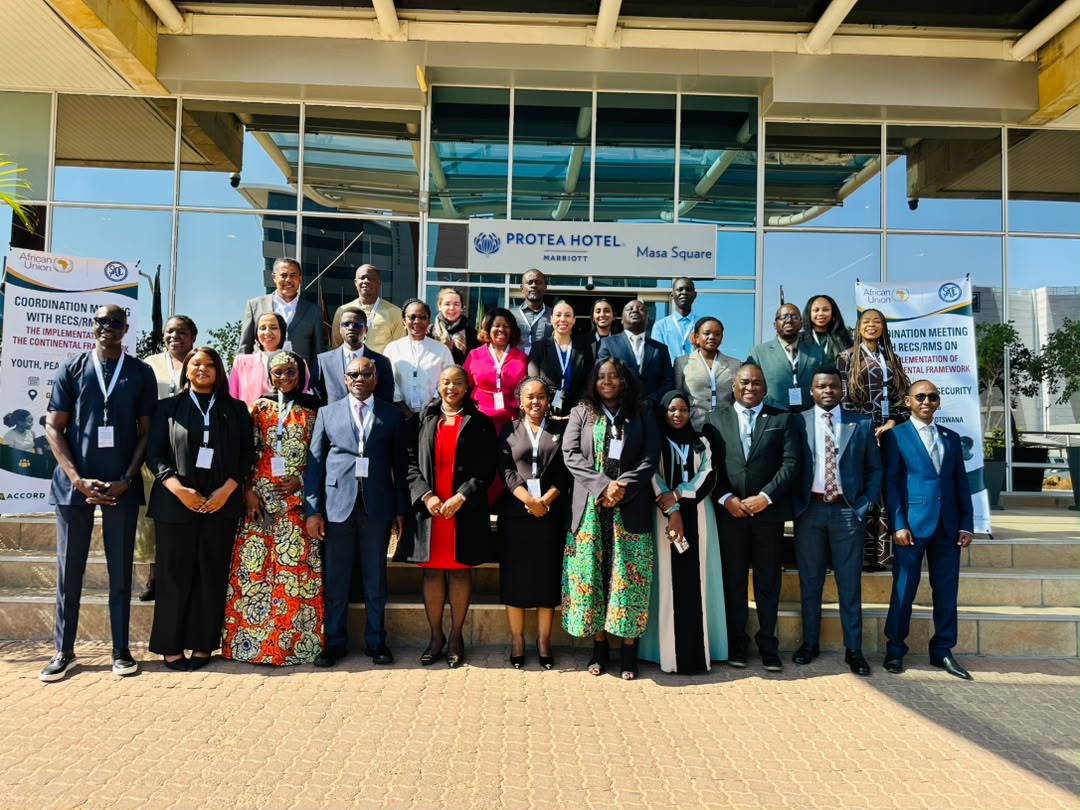
The African Union, in partnership with ACCORD through the Training for Peace, the Institute for Security Studies (ISS), and NeTT4Peace, convened a Regional Coordination Meeting with Regional Economic Communities (RECs) and Regional Mechanisms (RMs) in Gaborone, Botswana, from 28–29 July 2026. The meeting aimed to review the implementation progress of the AU’s Continental Framework on Youth, Peace and Security (CFYPS) at the regional level and initiate joint planning for the upcoming regional consultations that will inform the Framework’s mid-term assessment.
Bringing together representatives from RECs, RMs, the African Union Youth Ambassadors for Peace (AYAPs), co-chairs of the WiseYouth Network, and development partners, the discussions were focused on strengthening coordination and identifying opportunities for collaboration in advancing the YPS agenda across the continent.
Opening the meeting, Ms Ruth Kangwa, AYAP for Southern Africa, emphasised the importance of positioning the YPS agenda as both a peacebuilding and development priority. She highlighted the need to demonstrate how investing in young people’s participation in peace and security contributes to broader socio-economic outcomes, including poverty reduction and employment creation. Echoing her statement, Dr. Josephine Nwaelugo, AU Commission, and Mr. Kitenge Fabrice Tunda of the Southern African Development Community (SADC) encouraged participants to use the meeting to identify areas of complementarity and strengthen collaboration between the AU, RECs, RMs, and partners.
Representatives from the AU’s Youth4Peace Programme presented an update on the implementation of the CFYPS. Ms Gloria Kabage highlighted the AU’s support to Member States in developing National Action Plans (NAPs), including technical training for national working groups and the development of the NAP Development and Implementation Guideline, which is currently awaiting adoption by the AU Peace and Security Council (PSC). Following the AU, representatives from the RECs and RMs provided updates on progress made within their respective regions, highlighting both achievements and persistent challenges. They noted growing regional commitment to implementing the YPS agenda, while identifying limited institutional and financial capacity, the slow domestication of regional frameworks, and insufficient data on community-level implementation as key constraints. Participants also emphasised the need to institutionalise coordination and accountability mechanisms between the AU, RECs, RMs, Member States, and partners, strengthen monitoring and evaluation systems, and secure predictable financing to sustain implementation efforts.
The discussions also underscored the importance of strengthening coordination among RECs to promote more coherent reporting to the AU, reduce duplication of efforts, and maximise the comparative advantages of different partners.
The meeting introduced the Mid-Term Assessment of the 10-year Implementation Plan of the CFYPS, scheduled to commence in September 2026. Participants reviewed the proposed survey questionnaires and interview guides that will be used to assess progress made by the AU, RECs, RMs, and Member States since the adoption of the Framework. The assessment is expected to provide evidence on achievements, identify implementation gaps, and inform future priorities for strengthening the YPS agenda across the continent.
Closing the discussions, participants commended ACCORD’s continued partnership with the AU and RECs in strengthening the capacities of young people to contribute meaningfully to conflict prevention and peacebuilding. They also noted the important role partner organisations play in convening civil society organisations and supporting Member States to advance the implementation of the YPS agenda.
