
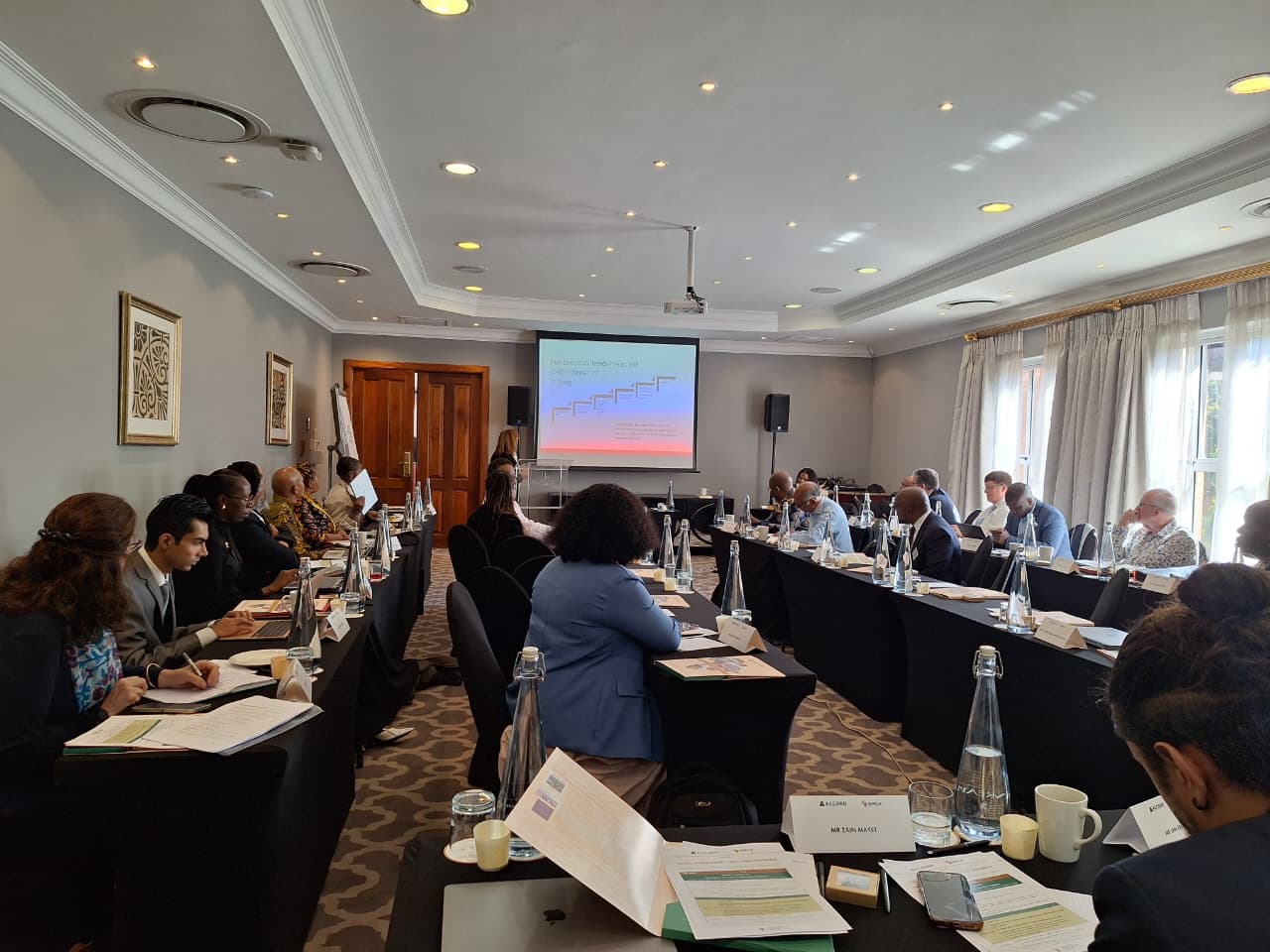
ACCORD, in partnership with the Elections Management and Consulting Agency (EMCA), convened a two-day seminar on Local Government Coalition Dynamics, from 19 to 21 August, in Johannesburg, South Africa. The seminar brought together political leaders, municipal officials, civil society and academics to reflect on the state of coalition governance ahead of the Local Government Elections scheduled for 4 November 2026.
The event commenced with welcome remarks from ACCORD’s Senior Political Advisor, H.E. Amb. Welile Nhlapo and H.E. Amb. Austin Gormley, Ambassador of Ireland to South Africa. These were followed by the keynote address, delivered by Adv Marna Dunkle-Kock, Chief Director: Municipal Governance in the Department of Cooperative Governance. Adv. Dunkle-Kock stated that the challenges often associated with coalition governance should rather be understood as part of a broader challenge of institutional resilience. She stressed that municipalities must remain able to govern effectively “regardless of political complexity.”
The remainder of the first day focused on the formal and informal factors that impact coalition formation, and on how these factors, and the governments formed under them, impact municipal functions. This included presentations by Prof. Susan Booysen, Dr Michael Sutcliffe, Mr Ashraf Adam, and Dr Tendai Mbuja, who respectively presented on the topics of electoral trends, coalition and election legislation, the impact of coalitions on municipal institutions and service delivery, and the factors that influence coalition stability and effectiveness. The day closed with an interactive session with Dr Zweli Mkhize, MP, Chairperson of the National Assembly’s Portfolio Committee on Cooperative Governance and Traditional Affairs, who discussed the role of parliament in overseeing local government and the legislative tools used, and being introduced, to do so. Dr Mkhize emphasised that, alongside legislation, it is essential to create a culture of cooperation in order to truly achieve effective and stable government coalitions.
The second day of the seminar saw presentation on the gender dimensions of coalition government by Dr Beauty Shiviti, and a look ahead to the 2026 Local Government Elections with Prof. Bheki Mngomezulu, who highlighted that more than 29 million voters are now registered nationally, with youth accounting for a significant share of new registrations. Finally, the seminar concluded with a presentation from Mr Lance Joel, Chief Officer: IGR & Municipal Resilience, at the South African Local Government Association. Mr Joel emphasised that we must formally define the principles, rules, procedures and sanctions that should apply to the political parties and councillors that attempt to govern together.
The seminar forms part of ACCORD’s ongoing work, including through its Coalitions Tracker, to deepen understanding of coalition politics in South Africa and support stable coalition governance ahead of, and beyond, the 2026 Local Government Elections.
