
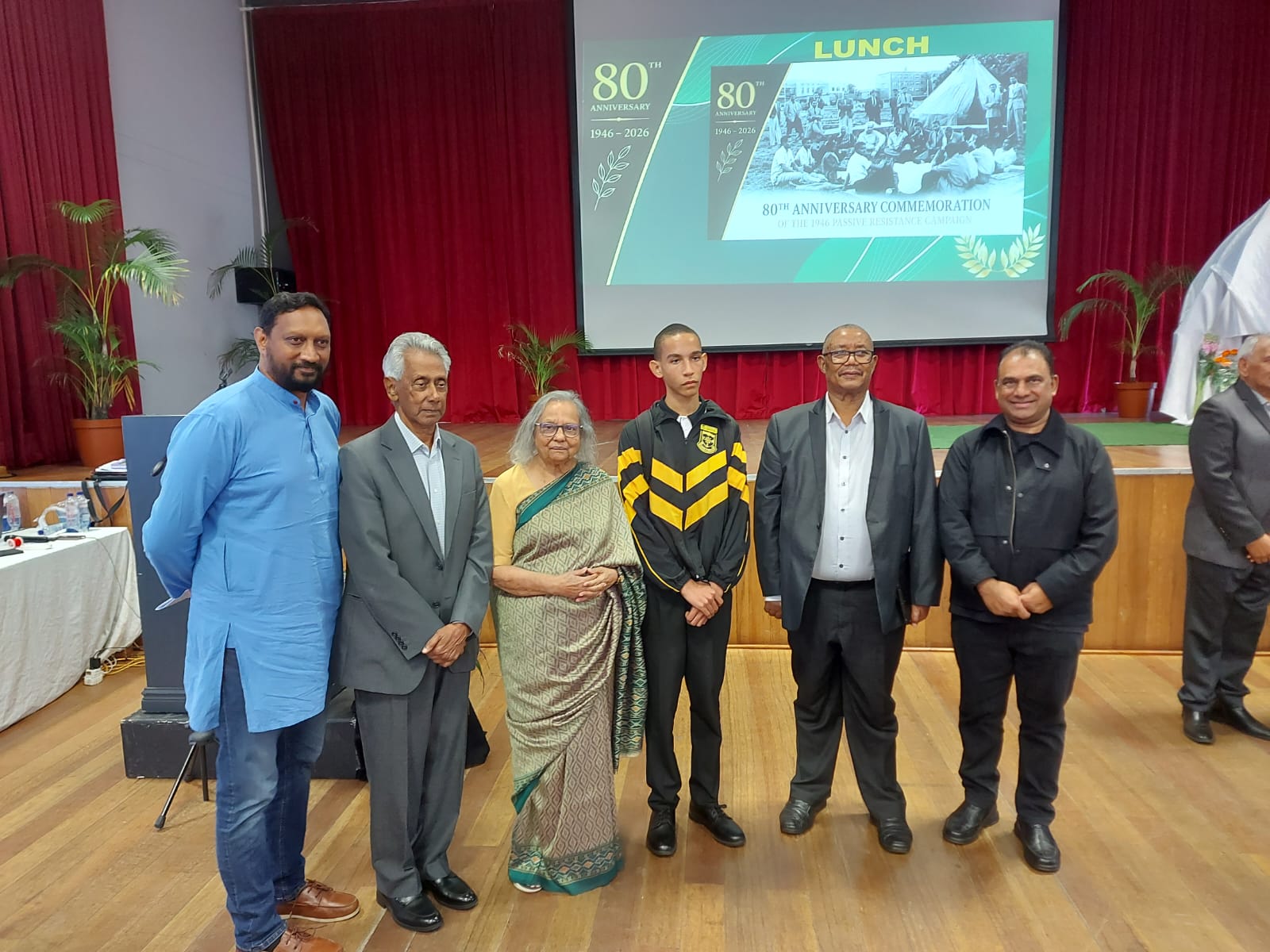
On 22 August 2026, the Founder and Executive Director of ACCORD, Dr Vasu Gounden, participated in an event held in Durban, South Africa, to commemorate the 80th Anniversary of the 1946 Passive Resistance Campaign. The event was organized by the Sastri College Alumni Society (SCAS). ACCORD Trustee, Professor Jairam Reddy, is the Chairperson of SCAS, and played a key role in the planning and hosting of the event.
The commemoration was divided into two parts consisting of a morning tribute held at the historic passive resistance site (Resistance Park) in Umbilo, Durban. This was followed by a legacy salute and cultural programme held at Sastri College.
Dr Gounden’s father, the late Swami Gounden, played a vital grassroots and organizational role in the 1946 Passive Resistance Campaign. His lifelong dedication, which began with the 1946 march, led to him receiving one of South Africa’s highest national accolades, the Order of Luthuli (Silver), before his passing in 2021 at the age of 94. Dr Gounden was one of the speakers on the programme in the session that highlighted reflections from families that participated in the Resistance Park campaign.
The 1946 campaign was launched by the Natal and Transvaal Indian Congresses to protest the Jan Smuts government’s racist Asiatic Land Tenure and Indian Representation Act (also called the “Ghetto Act”), which restricted land ownership and residential rights for Indian South Africans. Protesters intentionally occupied municipal land in Durban and pitched tents, willingly facing police indifference and brutal violence from white mobs. This historic mobilisation laid the essential groundwork for multi-racial collective action in South Africa, forging critical alliances between the African National Congress (ANC) and Indian organisations that directly informed the 1952 Defiance Campaign. Today, the campaign holds immense significance as it marked the first time South African institutional racism was successfully placed onto the global agenda of the newly-formed United Nations, serving as a timeless blueprint for ethical, non-violent resistance against oppression.
