
Sudan’s civil war is now in its fourth year, yet a political settlement remains elusive. While frequently portrayed as a fight between two rival generals, the conflict between the Sudanese Armed Forces (SAF) and the Rapid Support Forces (RSF) remains deeply embedded in a wider regional political economy in which external actors, financial networks, arms, diplomatic alliances and competing geopolitical interests continue to shape the strategic calculations of the warring parties.
However, the regional environment that has sustained the war is rapidly changing. In April, I argued that the conflict in the Middle East involving the United States, Israel and Iran presented the African Union (AU) with a rare strategic opening to reclaim leadership of Sudan’s peace process. The reasoning was straightforward: the war involving Iran had redirected the attention and resources of the Gulf states and other external powers towards their own security concerns.
That shift had consequences for Sudan, where external relationships have helped sustain the capacity of the warring parties to wage war. Four months later, the question is not whether the AU recognised that strategic opportunity, but whether it acted quickly enough to seize it.
A changing regional landscape
The regional consequences of the Iran war have been significant. Gulf states face heightened security and economic pressures, while maritime disruptions around the Persian Gulf have strained global fuel supplies and logistical networks. These developments have had consequences for Sudan’s already fragile war economy.
More importantly, the significance of these developments lies in Sudan’s structural vulnerabilities, as its war economy relies heavily on external military interests and relationships. Any weakening, redirection or recalibration of external support could therefore alter the incentives confronting the SAF and RSF. This was the strategic opening identified in April.
The AU had both the normative legitimacy and the institutional mandate to take the initiative. It also had an important advantage that external actors lacked: Sudan is not simply another geopolitical theatre for the organisation. Rather, it is an African crisis with direct consequences for neighbouring states, regional stability and the credibility of the continent’s commitment to ‘silencing the guns’.
The AU had both the normative legitimacy and the institutional mandate to take the initiative. It also had an important advantage that external actors lacked: Sudan is not simply another geopolitical theatre for the organisation
Tweet
Did the AU move far enough?
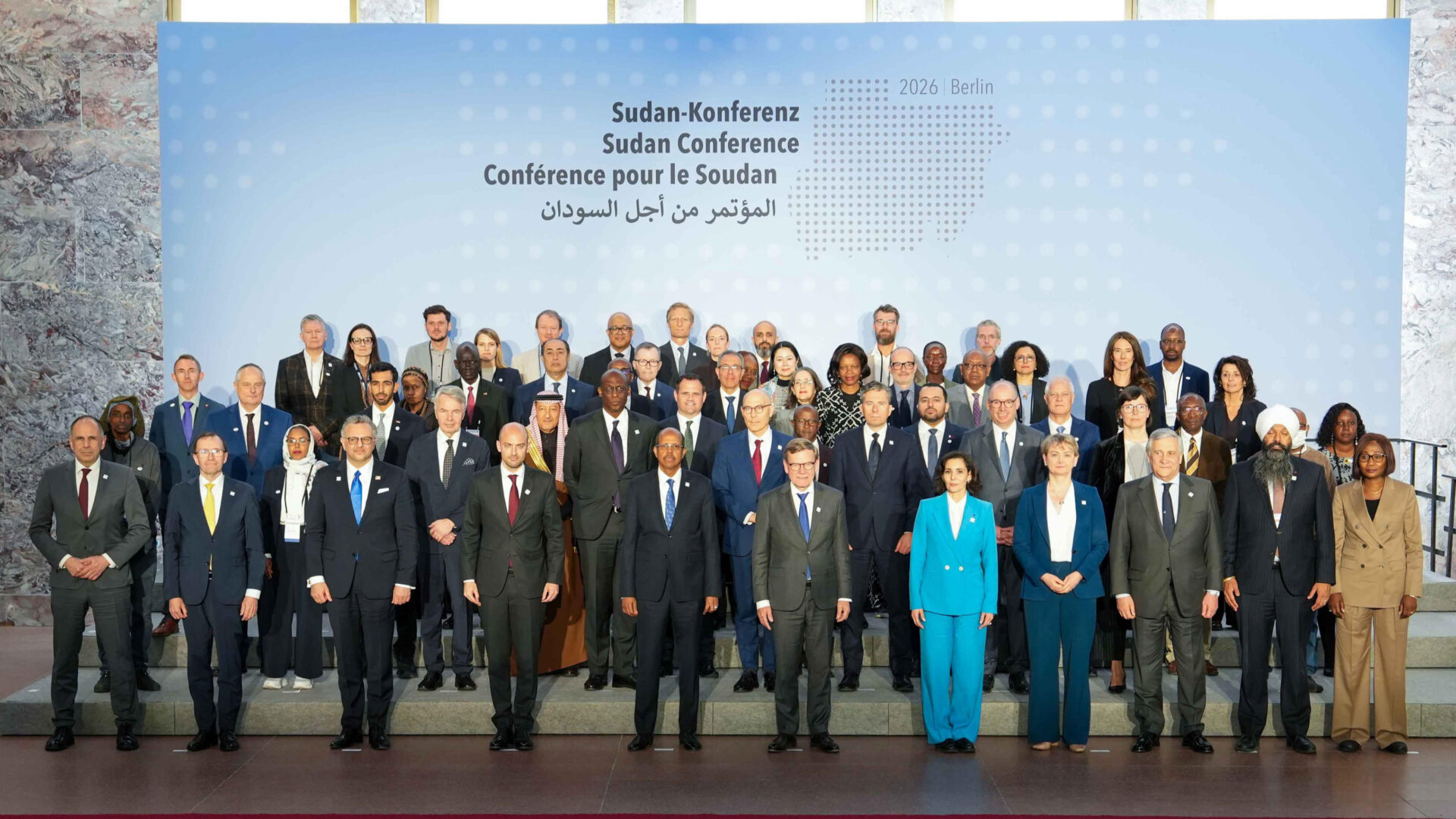
In April, the AU participated in the Berlin Sudan Conference alongside regional and international actors. In June, it participated in the Quintet consultations with Sudanese political stakeholders in Addis Ababa, Ethiopia. The AU has also maintained a Special Representative for Sudan, Ambassador Mohamed Belaiche, who met Sudan’s leader, Abdel Fattah al-Burhan, in Khartoum in July to discuss AU-led mediation efforts and the reopening of the AU Liaison Office.
By August, the AU was continuing consultations with Sudanese parties, alongside the Intergovernmental Authority on Development (IGAD), the League of Arab States, the European Union and the United Nations (UN). These are important interventions by the continental body, but they also expose the central problem: the AU is participating in the Sudan peace process, but it has not yet clearly established itself as the political centre of that process. The distinction between participating in and leading the process is critical.
From participation to leadership
Over the years, Sudan has seen a proliferation of diplomatic initiatives. International and regional actors have convened conferences, issued declarations and pursued parallel or overlapping mediation tracks. The problem has not necessarily been a shortage of diplomacy. It has been the absence of a sufficiently coherent political architecture capable of aligning these efforts around a credible, Sudanese-owned settlement.
This is precisely where the AU could have exercised greater leadership. Instead of being one institution within a broad diplomatic coalition, the AU could consolidate the various initiatives into a single continental political framework, appoint a sufficiently senior and empowered envoy, and use its convening authority to align IGAD, neighbouring states, the Arab League, the UN and external powers around an agreed political process.
Instead of being one institution within a broad diplomatic coalition, the AU could consolidate the various initiatives into a single continental political framework, appoint a sufficiently senior and empowered envoy, and use its convening authority to align IGAD, neighbouring states, the Arab League, the UN and external powers around an agreed political process.
Tweet
The April Berlin conference recognised the need for a peaceful and durable resolution based on principles that included the AU’s own roadmap and relevant African and international commitments. The question, therefore, is not whether the AU has a mandate – there is no doubt that it does. Rather, the question is whether it has converted that mandate into political leverage.
A narrowing window
This strategic window will not remain open indefinitely. On 24 August, media reports indicated that the United States had begun returning diplomatic personnel to Middle Eastern missions following the reduction in immediate hostilities with Iran. The geopolitical attention of Gulf and Western powers will most likely shift again. The opportunity created by temporary regional distraction may consequently be narrower than it appeared in April.
While this does not mean that the AU has lost its opportunity, it does mean that the window for decisive leadership is becoming more time-sensitive. Sudan’s crisis demonstrates why such leadership matters. The series of wars that have occurred in Sudan since the 1980s are deeply rooted in unresolved questions of state formation, ethnic, racial and political exclusion, regional security, resource control and the political economy of armed mobilisation.
A sustainable settlement will therefore require more than another elite bargain between General al-Burhan and Mohamed Hamdan Dagalo, the leader of the RSF. Given this complex reality, the AU should use its continental legitimacy to broaden the political process beyond the transactional logic that has characterised much of Sudan’s peace diplomacy.
The imperative for action
The point is not that the AU has missed the opportunity altogether. Its ongoing engagement demonstrates sustained institutional commitment. The issue is that engagement is not the same as leadership. The strategic circumstances that created an opening for stronger African leadership have changed.
The AU now needs to decide whether it will continue participating in a crowded international mediation architecture or use its mandate to organise that architecture around a genuinely African-led, Sudanese-owned political process. In April, the point was that external powers had looked away. Today, the question is whether the African Union is prepared to step forward.
Patrick K. Mbugua, PhD is a senior research fellow at ACCORD.
