
Why does a well-regarded, well-established mission struggle to convert climate awareness into climate-adaptive operations, even as the ground shifts beneath it, literally and figuratively? And why is its budget shrinking by a further 15 per cent at the very moment these risks are compounding?
Since 2011, the United Nations Interim Security Force for Abyei (UNISFA) has held a curious distinction: the UN Secretary-General has called it one of the continent’s best-performing peacekeeping missions, which is tasked with keeping the peace in a sliver of disputed territory wedged between Sudan and South Sudan. Yet, a new joint NUPI- TfP and SIPRI report, ‘Beyond the Blue Line: Tackling Climate, Peace, and Security Challenges in Abyei’, lays out the risks associated with changing weather patterns and broader climatic changes across the area. This is particularly timely given that the mission’s mandate is due for renewal this November.
UNISFA operates in one of the most climate-exposed conflict zones in Africa, a semi-arid area battered by temperatures that exceed 40°C during dry seasons and by increasingly erratic floods during its rainy season. Since 2024, its own mandate has formally recognised that climate change is reshaping the risks and exacerbating the nature of violence throughout the area. And yet, findings based on more than 40 interviews with mission staff, community members and officials across all three sectors of Abyei suggest that the mission’s response to climate shocks remains largely reactive rather than strategically adapted to the evolving context.
UNISFA operates in one of the most climate-exposed conflict zones in Africa, a semi-arid area battered by temperatures that exceed 40°C during dry seasons and by increasingly erratic floods during its rainy season
Tweet
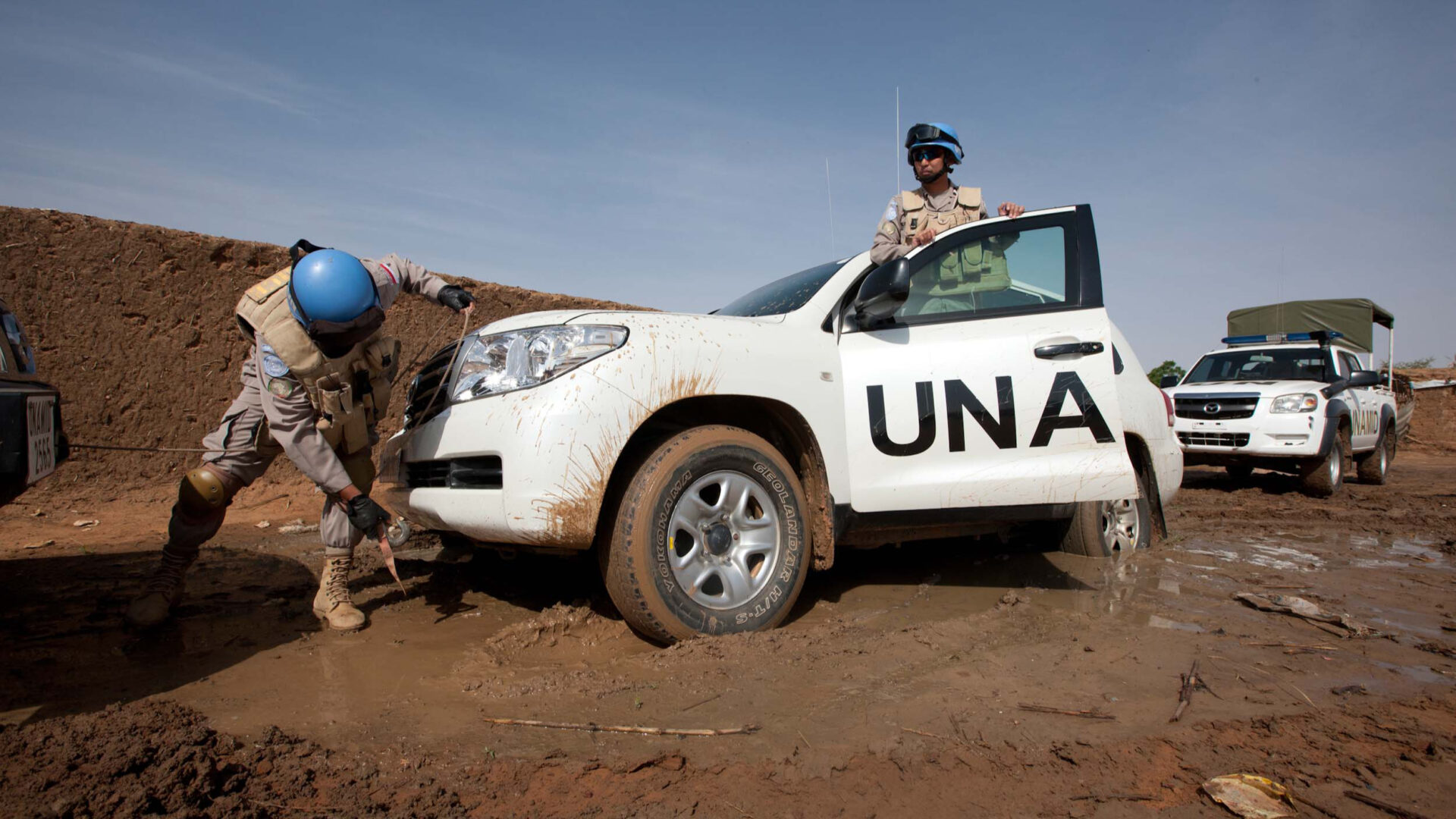
The report highlights several interlocking problems. The first concerns the basic mobility of UNISFA forces. Abyei’s roads are not weatherproof, and during the rainy season, the main supply route that links UNISFA’s Force Headquarters to its Command Operating Bases regularly turns into a muddy-impassable route. Vehicles, including the mission’s own, get stuck, and heavy engineering equipment has to be diverted to rescue them. UNISFA still lacks sufficient all-terrain vehicles, inflatable boats and air or sea assets to compensate for these constraints, leaving troops reliant on improvised solutions. Vietnamese engineers, for example, have resorted to building their own boats to adjust and adapt to the impacts of climate change in the area.
The second issue is the mission’s posture which tends to be reactive rather than anticipatory. Flooding and drought in Abyei follow broadly predictable seasonal patterns, yet, as one senior political and military official told the researchers, the mission does not ‘take the necessary steps to pre-empt’ them. Early-warning systems exist in fragmented form but are not systematically linked to patrol data, protection-of-civilians planning or climate risk analysis.
Third, the report finds that adaptation is taking place, but unevenly and without coordination. Individual battalions have found their own solutions. Ghana’s battalion in Sector South, for example, has adopted flexible foot patrols in areas where vehicles cannot pass. The forces have repositioned troop-contributing country locations closer to key flashpoints. However, these remain sector-specific improvisations rather than a mission-wide strategy, and ‘spreading thin’ across a wider area is not the same as effectively deterring violence.
Fourth, and perhaps most consequentially, climate stress is colliding with a changing threat environment. The war in Sudan has pushed elements of the Rapid Support Forces (RSF) into Abyei. Meanwhile, Nuer militia and, at times, hired elements are contracted seasonally to conduct cattle raids and attacks, often during the periods when flooding limits UNISFA’s mobility. In addition, South Sudan’s security forces have continued to remain inside Abyei, establishing checkpoints within the supposedly demilitarised area in violation of the agreements underpinning the mission’s presence.
Taken together, the report’s findings paint a picture of a mission caught between mandate and means. Between October 2025 and March 2026 alone, UNISFA recorded 196 security events, resulting in 58 deaths and 69 injuries, most of them concentrated in Sector North. These figures should be read alongside 15 recorded cases directly involving the RSF, as well as a marked rise from the 91 incidents and 22 fatalities in the preceding period.
Meanwhile, conflicts in Sudan and dire violence in South Sudan have caused the population living inside the disputed area to grow sharply. Displacement as a result of Sudan’s civil war has pushed thousands of people into informal settlements around Diffra and Amiet Market, straining already limited health and water services and creating new tensions over land, grazing and cattle. Flooding alone has displaced more than 24 000 people.
Troop-contributing countries’ own medical facilities, designed for peacekeepers, now face a ‘dual burden’ of treating local patients alongside soldiers, further stretching capacity already under pressure from climate-driven disease outbreaks such as cholera, typhoid and malaria. Despite all this, UNISFA has no explicit mission-wide climate, peace and security (CPS) strategy. Its environmental and civil-military cooperation work, including medical outreach, veterinary services and water provision, helps to mitigate the symptoms of climate stress but is not integrated into the mission’s core protection-of-civilians planning. Consequently, the report notes a persistent disconnect between the mission’s internally focused environmental team and its externally facing protection work.
Community-level efforts fare somewhat better. For example, pre- and post-migration dialogues convened by UNISFA’s Community Liaison Office, bringing Ngok Dinka and Misseriya representatives together to negotiate access to water points and grazing corridors before seasonal movements begin, are contributing to a reduction in violent incidents. However, the authors caution that these dialogues remain fragile improvisations rather than institutionalised early-warning mechanisms, vulnerable to the same resource and climate pressures they are meant to manage.
All of this is unfolding against the backdrop of a mandated 15 per cent budget cut driven by the UN’s broader peacekeeping liquidity crisis, forcing UNISFA to scale back precisely the situational-awareness and mobility capabilities it needs most. At the same time scientists are warning that an autumn 2026 El Niño is likely to bring greater rainfall variability to the region.
The report’s recommendations, offered ahead of UNISFA’s mandate renewal discussions this November, point toward a mission that does more with less by working smarter rather than simply becoming leaner
Tweet
The report’s recommendations, offered ahead of UNISFA’s mandate renewal discussions this November, point toward a mission that does more with less by working smarter rather than simply becoming leaner. Chief among them is the case for a dedicated CPS advisor embedded at the senior (P5) level, potentially funded through member-state initiatives such as Norway’s Norwegian Capacity (NORCAP), to better integrate the mission’s environmental work with its protection of civilians and women, peace and security strategies.
Closely related is the call to link patrol data, early warning and CPS analysis into one coherent system, drawing on the developed practices and lessons learned from the United Nations Mission in South Sudan rather than leaving each troop-contributing contingent to invent its own seasonal workaround. The report also urges the UN Department of Peace Operations (DPO) to overhaul pre-deployment training and equipment requirements so that units arrive prepared for extreme weather, with equipment such as inflatable boats, all-terrain vehicles and foot-patrol capability in flooded terrain, and standard weather-monitoring routines before operations begin. The DPO should also develop a mission-specific CPS manual so that staff at every level understand what CPS means for their work, rather than leaving this understanding to headquarters planners alone.
On the political side, the report calls on the UN Security Council to keep explicit CPS language in UNISFA’s mandate when it comes up for renewal, and on the UN Secretary General’s periodic reporting to give greater visibility to how climate stress is shaping the mission’s environment.
Finally, the authors point to the value of partner-backed joint projects, building on the UN Environmental Programme’s ongoing European Union-funded work with UNISFA to strengthen shared natural resource management between communities. They argue that this approach could be a way of addressing the underlying resource competition that climate change is intensifying, rather than merely policing its consequences. None of this requires reinventing UNISFA. It does, however, require treating climate change as an evolving driver of insecurity and conflict dynamics that the mission has to manage, rather than a footnote to be addressed once the floodwaters have already cut off the road.
Dr. Andrew E. Yaw Tchie is a senior researcher and coordinates the Training for Peace Programme at the Norwegian Institute of International Affairs (NUPI). Katongo Seyuba is a researcher with the Climate Change and Risk Programme at the Stockholm International Peace Research Institute (SIPRI).

