
Contemporary conflicts, deepening geopolitical divisions, and growing financial constraints have intensified debate about the future effectiveness of United Nations (UN) peace operations. In response to the Pact for the Future, the UN Secretary-General’s 2026 Review of the Future of All Forms of United Nations Peace Operations calls for a fundamental reset of peace operations to meet the demands of a changing geopolitical landscape. The review highlights increasingly complex and protracted conflicts, evolving security threats, strained host-state relations, and mounting resource pressures, all of which challenge the assumptions underpinning traditional peace operations. It argues that future missions must be more politically focused, adaptable, and efficient, while collaborating more effectively with diverse actors to align expectations with operational, financial, and political realities.
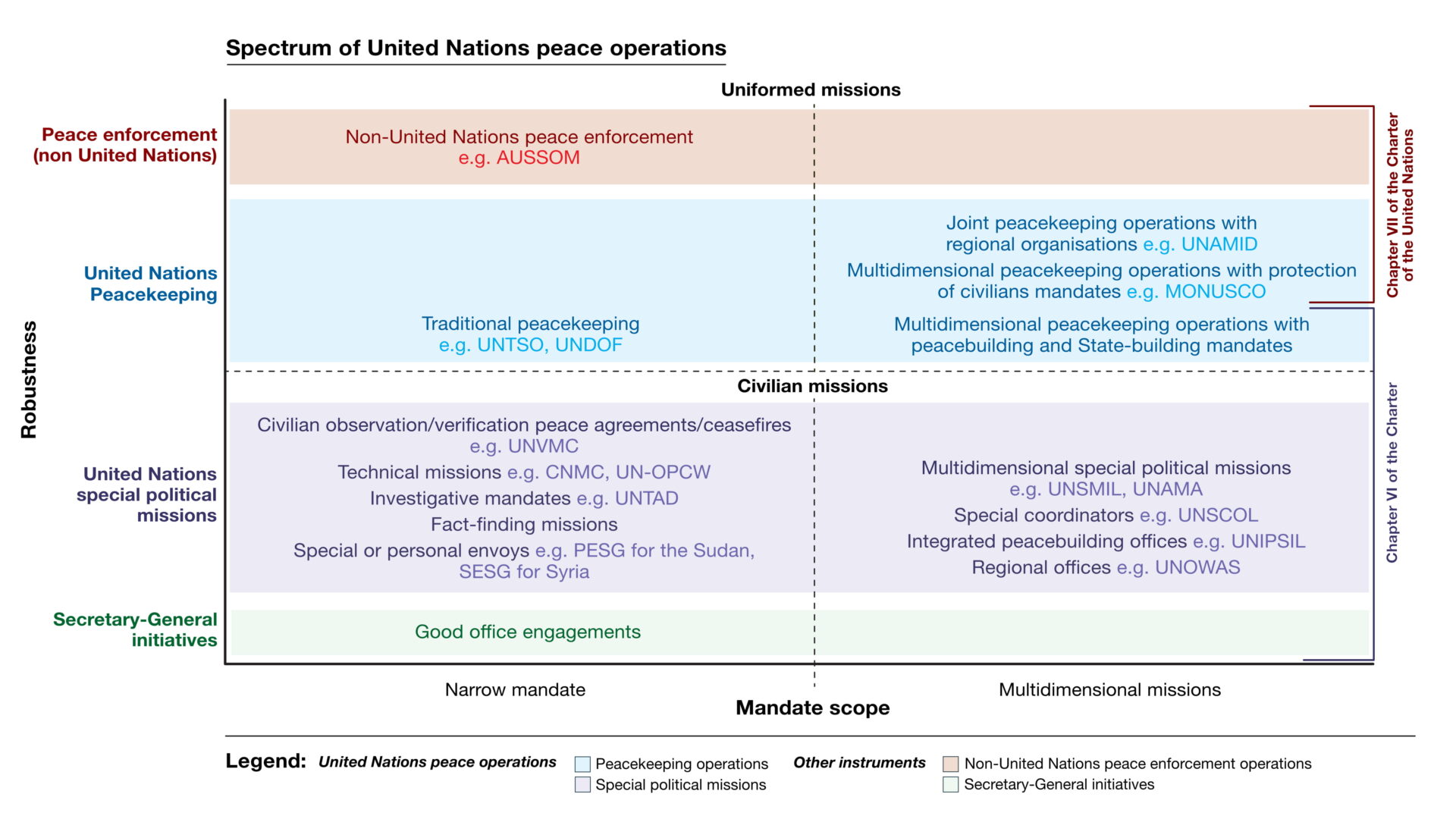
A renewed focus on peacemaking and the primacy of politics is at the heart of the report. It makes clear that diplomacy, dialogue and mediation must continue to be central to efforts to prevent and resolve conflicts, and that peace operations should be implemented in support of an identifiable political process. Recognising that not every crisis necessitates a large field mission, the report also calls for greater use of the Secretary-General’s good offices, regional offices and envoys. A recent example can be seen in the Democratic Republic of the Congo (DRC), where the UN has combined the presence of the UN Organisation Stabilisation Mission in the DRC (MONUSCO) with broader diplomatic and regional engagement. In June 2026, the Head of MONUSCO and the UN Special Envoy for the Great Lakes undertook a joint regional engagement, participating in an African Union (AU)-led assessment of the crisis in eastern DRC and engaging with the International Conference on the Great Lakes Region (ICGLR) and the AU Commission. The engagement sought, among other things, to align regional mediation efforts, strengthen ceasefire-monitoring arrangements and improve coordination between the UN and regional actors. This illustrates the type of complementary approach envisaged in the review, with field missions, envoys and regional mechanisms operating alongside each other and sharing the political burdens. While missions can help contain violence, protect civilians and foster dialogue, they cannot substitute for sustained international engagement or political consensus among the conflict parties, making the review’s emphasis on politics therefore both practical and important.
The report reiterates UN impartiality while advocating for stronger partnerships with host states. Although host-state consent and cooperation are essential, there are instances where state authority is disputed, governments are involved in hostilities, or national and international agendas diverge. The experience of the United Nations Multidimensional Integrated Stabilisation Mission in Mali (MINUSMA) illustrates the consequences of that political relationship breaking down. In June 2023, after Mali’s transitional authorities called for the mission’s immediate withdrawal, the Security Council terminated MINUSMA’s mandate and provided for the withdrawal of its personnel by the end of that year. The episode demonstrated that host-state consent must be sustained throughout the life of a mission, not just at the point of entry. Once that consent significantly erodes, the space for a peace operation to implement even a Security Council-authorised mandate can become untenable. It will continue to be challenging to strengthen national ownership without compromising impartial political engagement or protection of the civilians.
Another key element of the reset is the call for more focused, adaptable mandates that prioritise areas of comparative advantage, particularly political and security tasks, while pursuing realistic objectives aligned with available resources. The review also recommends that mandate renewals be used more strategically to restructure missions, discontinue tasks and plan transitions and exits. The experience of MONUSCO also demonstrates why such transition planning cannot be treated as a fixed timetable. Following the Mission’s withdrawal from South Kivu in 2024, the DRC and the UN subsequently paused further disengagement as the security situation deteriorated. The Security Council has subsequently emphasised that any further withdrawal should be gradual, responsible and sustainable. Exit strategies are necessary, but they must remain responsive to changing conflict dynamics and protection risks, while needing to be mindful of the realities on the ground.
Missions have frequently been assigned large mandates without adequate resources or political support. Greater focus may increase prioritisation and accountability, however, limiting mandates raises an equally critical question: who will fill the roles that peace operations no longer perform? The review proposes a more defined division of labour across the UN system, with agencies, funds and programmes taking on programmatic responsibilities while peace operations focus on political and security issues. This could reduce duplication and facilitate transitions, but only if the wider UN system has the capacity and financing to take on those responsibilities. Without an effective transfer of responsibilities accompanied by the necessary capacity and resources, streamlining may result in gaps in peacebuilding, governance, the rule of law and protection support.
Efficiency can reduce unnecessary bureaucracy and improve mandate delivery, but it cannot substitute for the capabilities required to operate safely and effectively. A more agile mission must still be adequately equipped.
Tweet
Additionally, the review emphasises cost-effectiveness, efficiency and agility, calling for more flexible and adaptable mission structures, quicker deployment, improved use of technology and administrative changes that enable mission leadership to react more swiftly to changing circumstances. The report notes a reduction in costs for special political missions and a nearly US$500 million reduction in the peacekeeping budget for 2026/27, while also recording that the liquidity crisis affecting peacekeeping had already resulted in the repatriation of thousands of peacekeepers beginning in late 2025. The report simultaneously calls for better mobility, stronger medical support, enhanced situational awareness, specialised capabilities and greater use of technology, however, the challenge will be to distinguish genuine efficiencies from reductions that could constrain missions’ ability to perform their tasks under the new model. Efficiency can reduce unnecessary bureaucracy and improve mandate delivery, but it cannot substitute for the capabilities required to operate safely and effectively. A more agile mission must still be adequately equipped.
The review also links the future of peace operations to a wider question of representation and legitimacy within the multilateral system, arguing that the Security Council continues to reflect the geopolitical realities of 1945. It specifically identifies Africa’s underrepresentation as a historical injustice that needs to be addressed. This is particularly relevant to peace operations, given the Council’s central role in determining when missions are established, the mandates they receive, the resources and political backing available to them, and when they are reconfigured or withdrawn. Reforming peace operations while leaving the principal body responsible for authorising them disconnected from contemporary geopolitical realities would therefore leave part of the underlying problem unresolved.
The reset calls for closer collaboration between peace operations and non-UN security actors, member states and regional and subregional organisations. The Secretary-General’s report makes the case that partnerships should be founded on context and comparative advantage, and that there is no one model for future mission configuration. Security Council Resolution 2719 (2023), which established a structure for funding AU-led peace support operations through UN assessed contributions on a case-by-case basis, is one significant example of the UN-AU partnership. Somalia provides a useful illustration of what a more networked configuration can look like in practice. Rather than the UN itself deploying the principal uniformed operation, the United Nations Support Office in Somalia (UNSOS) provides extensive logistical support to the AU-led AUSSOM, including food, water, fuel, aviation, medical evacuation, communications, equipment support and assistance with the movement and rotation of personnel. This provides a practical example of the type of networked approach envisaged in the Secretary General’s review, in which the UN can retain political and enabling roles without necessarily being the principal uniformed actor on the ground. For such arrangements to work effectively, the report calls for more comprehensive joint planning, improved interoperability and clearer delineation of roles and responsibilities. More generally, this suggests that, rather than constantly serving as the main operational actor, the UN may increasingly serve as a political partner, strategic enabler or provider of specialised support in the future.
The review also links the future of peace operations to a wider question of representation and legitimacy within the multilateral system, arguing that the Security Council continues to reflect the geopolitical realities of 1945. It specifically identifies Africa’s underrepresentation as a historical injustice that needs to be addressed
Tweet
The Secretary-General’s review suggests neither the end of traditional peacekeeping nor a single replacement model. Rather, it calls for a more differentiated system of peace operations that is politically grounded, more narrowly focused in its mandate, more adaptable in its configuration, and more integrated with the wider UN system and regional partners. However, implementation will be the key challenge and the proposed reset is as much about making difficult political choices as it is about restructuring missions. Ultimately, whether member states provide the political cohesion, resources and sustained engagement that the report identifies as essential will determine whether the proposed reset can be translated from an ambitious reform agenda into more effective UN peace operations.
Rumbidzaishe Mupfiga is a Programme Officer within ACCORD’s Peace Support Operations Unit.
