
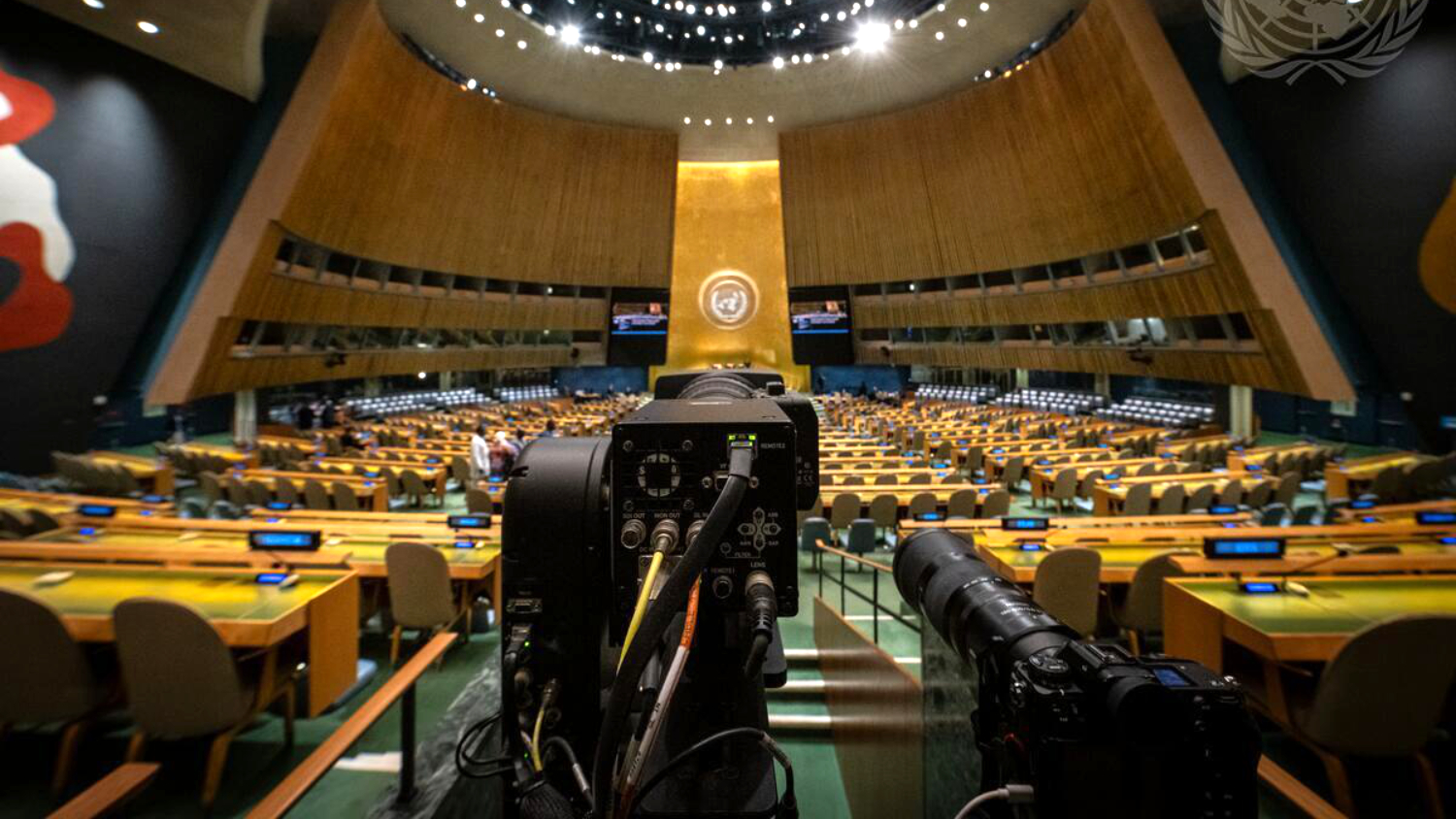
As the high-level week of the 81st United Nations (UN) General Assembly (UNGA) draws to a close, the headlines have been dominated by war, great-power rivalry and warnings about runaway technology. The overall pattern that many analysts and journalists have identified in recent years is that of a multilateral system in decline. A different picture emerged at UNGA 81: one of a world that still overwhelmingly turns to the United Nations to solve problems that no country can tackle alone.
The world still believes in cooperation
The most important message from UNGA this year is that the vast majority of the UN’s 193 member states continue to believe in international cooperation, international law and multilateral solutions. Speech after speech in the General Debate called for a stronger, reformed UN, not a weaker one.
Only a handful of countries are choosing to act outside international law and the multilateral system. Yet even they still come to the UN to make their case. The United States (US) President used the podium to threaten Iran and to reject calls for tighter controls on artificial intelligence (AI). Israel’s Prime Minister used his address to defend the war in Gaza and to attack Israel’s critics, including some of its closest allies. These speeches were delivered in person in the UN General Assembly Hall because the UN is still the one place where the whole world gathers. The UN’s convening power, even for its sharpest critics, remains resilient and intact.
The most important message from UNGA this year is that the vast majority of the UN’s 193 member states continue to believe in international cooperation, international law and multilateral solutions. Speech after speech in the General Debate called for a stronger, reformed UN, not a weaker one
Tweet
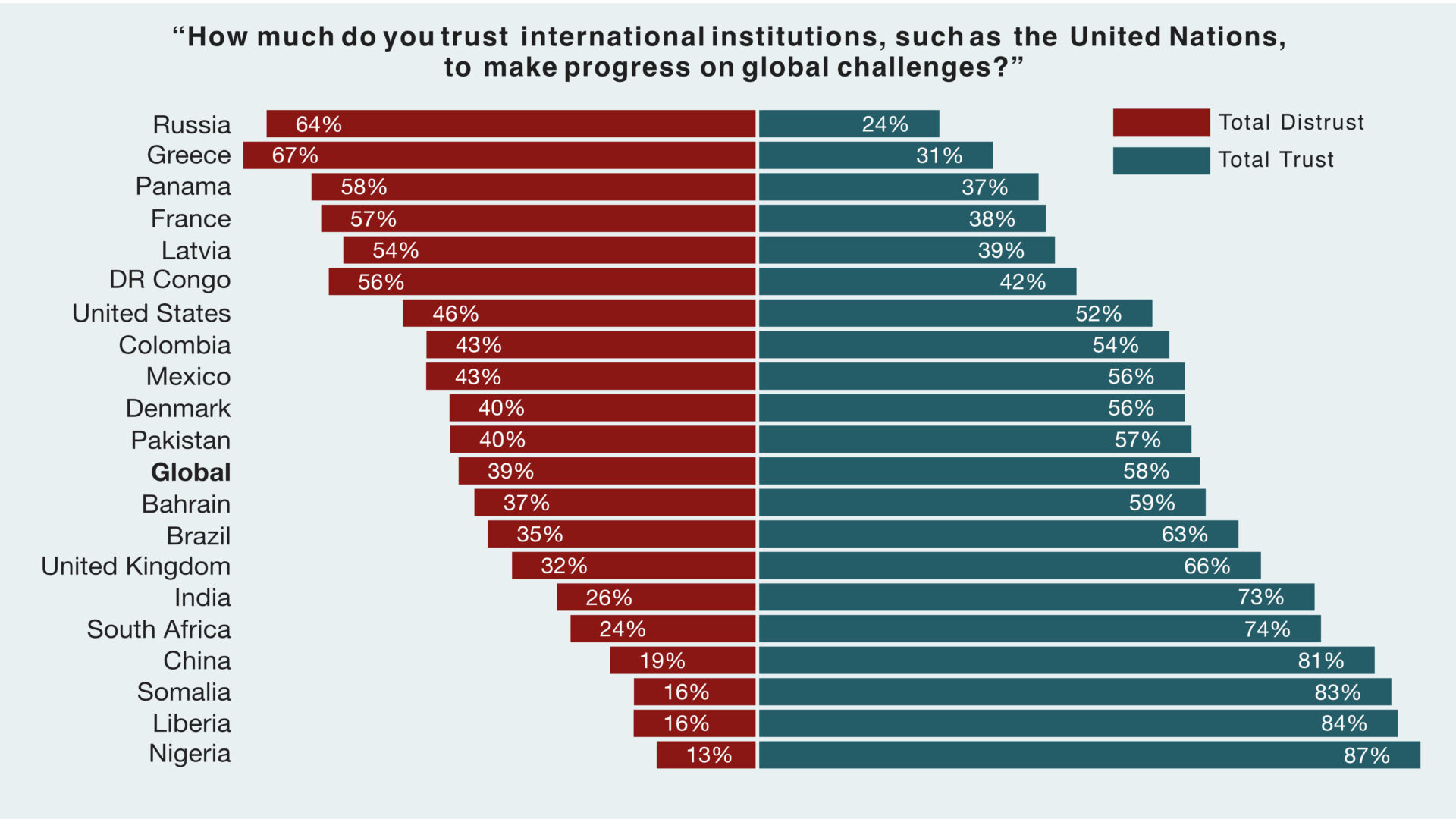
It is not only governments that still believe in the UN; ordinary people across the world do too. A new UN Foundation poll, released just before the high-level week, found that nearly 90 per cent of respondents in 20 countries believe that even powerful nations cannot tackle global challenges alone, while 58 per cent trust the UN to deliver results. The Rockefeller Foundation’s 2026 global poll of more than 35 000 people in 34 countries found that although 69 per cent feel the world has gotten worse over the past year, 57 per cent want their country to cooperate on global challenges even when it means compromising on national interests. In addition 61 per cent support countries working together even without the United States or China. The Pew Research Center found that a median of 55 per cent across 37 countries view the UN favourably, and Gallup found that, across 137 countries, nearly twice as many people approve of the UN’s performance (50 per cent) as disapprove (26 per cent). That support is not unconditional as people want a UN that delivers, but the message from the public is clear: they want more international cooperation, not less.
Guterres bows out
UN Secretary-General António Guterres delivered his final address to the General Assembly on 22 September. He framed the moment around four ‘tests of power’: war or peace, inequality, climate change and AI. These tests, he argued, will decide whether the world moves towards a new era of cooperation or deeper division. He warned the superpowers to recognise ‘that their power isn’t so super’, and insisted that military might alone cannot secure peace. He closed by vowing to keep championing the conviction that peace is possible after he leaves office, and left the rostrum to a sustained standing ovation.
That ovation came despite years of criticism that he did not do enough, particularly in peacemaking. The wars in Ukraine, Gaza and Sudan exposed the limits of the Secretary-General’s good offices when the Security Council itself is paralysed.
Yet his decade in office leaves a substantial legacy. He made climate action the moral centre of his tenure, relentlessly pressing for greater Paris Agreement ambition and launching the Early Warnings for All initiative. He helped broker the 2022 Black Sea Grain Initiative, which kept Ukrainian grain flowing to global markets during wartime. He championed the 2024 Pact for the Future and its Global Digital Compact, as well as the UN’s Independent International Scientific Panel on AI. He also achieved gender parity in the UN’s senior leadership and launched the UN80 reform initiative to make the organisation leaner and more effective.
The race to succeed him: still wide open
The selection of the next Secretary-General loomed over the week. The Security Council held its third straw poll on 18 September, just before leaders arrived. According to diplomats, Costa Rica’s Rebeca Grynspan, head of UN Trade and Development (UNCTAD), regained the lead with nine ‘encourage’ and five ‘discourage’ votes. Guyana’s Carolyn Rodrigues-Birkett, who had narrowly topped the August round, followed closely with eight ‘encourage’ votes.
The day after the poll, former Chilean President Michelle Bachelet withdrew her candidacy, leaving seven candidates in the race. No candidate yet appears able to command the support of all five permanent members, and new entrants remain possible. With Guterres’s term ending on 31 December, the pressure is mounting. In both 2006 and 2016, the final straw poll was held in early October, so the coming weeks will be decisive. The question of whether the UN will finally appoint its first woman Secretary-General remains open. The Security Council Report provides an excellent overview of the selection process.
AI comes to the Security Council
In one of the week’s most striking moments, the Security Council held a high-level briefing on artificial intelligence and international security on 23 September, convened by France. OpenAI CEO Sam Altman and Anthropic CEO Dario Amodei, who spoke by video, briefed the Council alongside Hugging Face CEO Clément Delangue and Yoshua Bengio, co-chair of the UN’s Independent International Scientific Panel on AI.
The heads of two rival companies delivered a shared message: AI needs international standards and cooperation, or global security is at risk. Amodei called AI the most important global security issue facing the world today. He proposed three areas for cooperation: narrow global agreements, such as a ban on using AI to develop biological weapons; evaluation and verification systems so that countries can check each other’s commitments, and common testing standards and a notification system for AI incidents with global security implications. Altman pointed out that rival states have come together before in the face of powerful new technologies. He cautioned against ‘doomerism’ and proposed a middle path built on three principles: AI must remain under human control, it must benefit people, and it must empower individuals. Bengio warned that AI beyond human control would pose an unprecedented threat that no country could contain alone.
Africa demands a seat at the table
For Africa, the defining issue of the week was Security Council reform, and African leaders made the case with rare unity. Kenya’s President William Ruto told the Assembly that ‘the equality proclaimed in this assembly ends at the doors of the Security Council’, noting that Africa’s 54 states, more than a quarter of the UN’s membership, remain ‘permanently discussed, yet permanently excluded’. Nigeria restated the Common African Position calling for two permanent seats with veto rights and five non-permanent seats, and Guterres himself called Africa’s exclusion ‘unjust and indefensible’. African leaders also tied the reform of global governance to the reform of global finance. Ruto warned that ‘capital must price risk, it must not price prejudice’, pointing out that African countries borrow at two to four times the rates paid by developed economies. Ghana’s President John Mahama launched the final report of the Accra Reset, A Sovereign Future for Health, which calls for countries of the Global South to take ownership of their health systems under the principle of ‘no ownership without control’. The message from the continent was clear: Africa is not asking for aid, but for a fair share of decision-making power in the institutions that shape its future.
For Africa, the defining issue of the week was Security Council reform, and African leaders made the case with rare unity
Tweet
Climate change as a national security risk
On 23 September, the United Kingdom, the European Union and Kenya co-hosted a foreign ministers’ dialogue on climate change and ecosystem degradation as national security risks. In their joint statement, the co-hosts described the climate and nature crisis as a national and global security threat. They warned that some ecosystems could begin to collapse from 2030, with cascading risks including conflict, displacement and competition over resources.
The co-hosts made several commitments such as: to integrate climate and nature risks into national security analysis and horizon scanning; to share analysis and conduct joint risk assessments; to expand early warning systems, anticipatory action and pre-arranged finance; and make multilateral development banks’ crisis toolkits fit for an era of frequent climate shocks. They also called on UN agencies to embed climate security and conflict-sensitive approaches, drawing on the UN Climate Security Mechanism.
Recognising the security implications of climate change is more than a question of framing. It helps prevent and manage conflict in fragile regions, where climate shocks intensify existing tensions. It also strengthens the case for investing in adaptation, preparedness and resilience. When climate change is treated as a security issue, it can compete for the attention and budgets that other security issues command.
Conclusion: under pressure, not buried
This year’s high-level week did not resolve the wars dividing the world or the tensions between major powers. But it offered a clear rebuttal to those who claim multilateralism is dead. Leaders came, argued and listened. The Security Council opened itself up to one of the defining technologies of the century. African leaders made a united case for a fair seat at the table. Ministers from three continents redefined climate change as a security challenge. And an outgoing Secretary-General reminded the world that cooperation is not naïve, but necessary.
Multilateralism is under real pressure, but UNGA 81 showed how resilient the UN is. Despite sharp criticism, deep budget cuts and far-reaching reform, the world’s leaders still came to New York, because the UN remains the place to look for shared solutions to shared problems.
Cedric de Coning is a senior advisor for ACCORD and a research professor at the Norwegian Institute of International Affairs (NUPI)
