
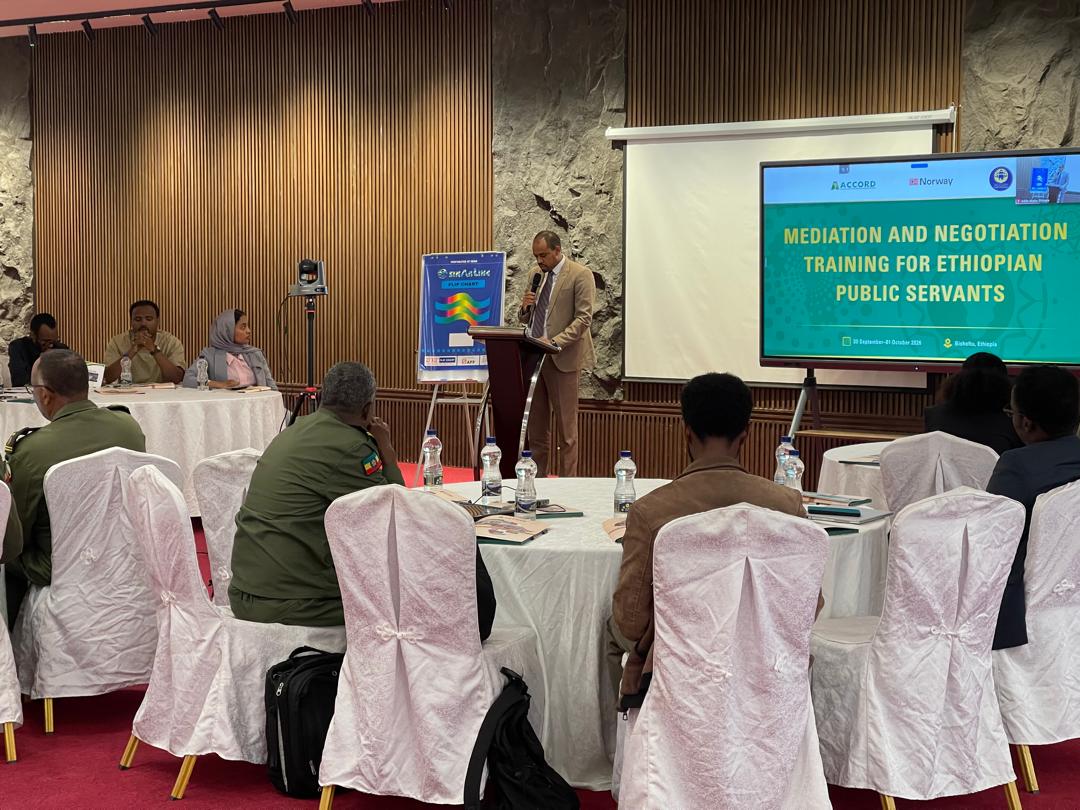
On 30 September 2026 the Founder and Executive Director of ACCORD, Dr Vasu Gounden, virtually presented the opening session of a two-day Mediation and Negotiation Training for Ethiopian Public Servants. The training, which will take place from 30 September to 01 October 2026 in Bishoftu, Ethiopia is hosted by ACCORD in collaboration with the Ethiopian Institute of Foreign Affairs.
The training will bring together more than 30 individuals from across Ethiopia’s public institutions. Participants include Ambassadors and officials from the Ministry of Foreign Affairs, members from the House of Peoples’ Representatives, senior officers from the Ethiopian National Defence Force, and representatives from the Ministries of Justice, Peace and Defence. Participants from the Ethiopian Institute of Foreign Affairs, the Prosperity Party, the National Intelligence Service and the Institute for Peace and Security Studies also took part.
In his virtual presentation, Dr Gounden set the scene for the training by looking at the structural pressures shaping Ethiopia and the continent. These include rapid population growth, unemployment, governance erosion, cross-border armed networks, and a global shift from “peace through dialogue” to “peace through strength”. He closed by setting out six questions that policymakers and practitioners must answer when considering intervention: whether to intervene, when, with whom, with what tools, to what end, and how to exit.
The objectives of the training are to i) deepen participants’ understanding of conflict dynamics; ii) build practical skills in conflict analysis; iii) give participants hands-on experience of the mediation process; and iv) explore how peace agreements are drafted, implemented and sustained.
The training will use a participatory learning approach, with participants sharing their own experiences of intervening in conflict. There will also be insights from experienced African mediators, such as ACCORD’s Senior Political Advisor, H.E. Ambassador Welile Nhlapo.
ACCORD’s delivery of this training reflects its ongoing commitment to building African capacity for the peaceful resolution of conflict and to supporting African-led and African-owned approaches to peace.
