
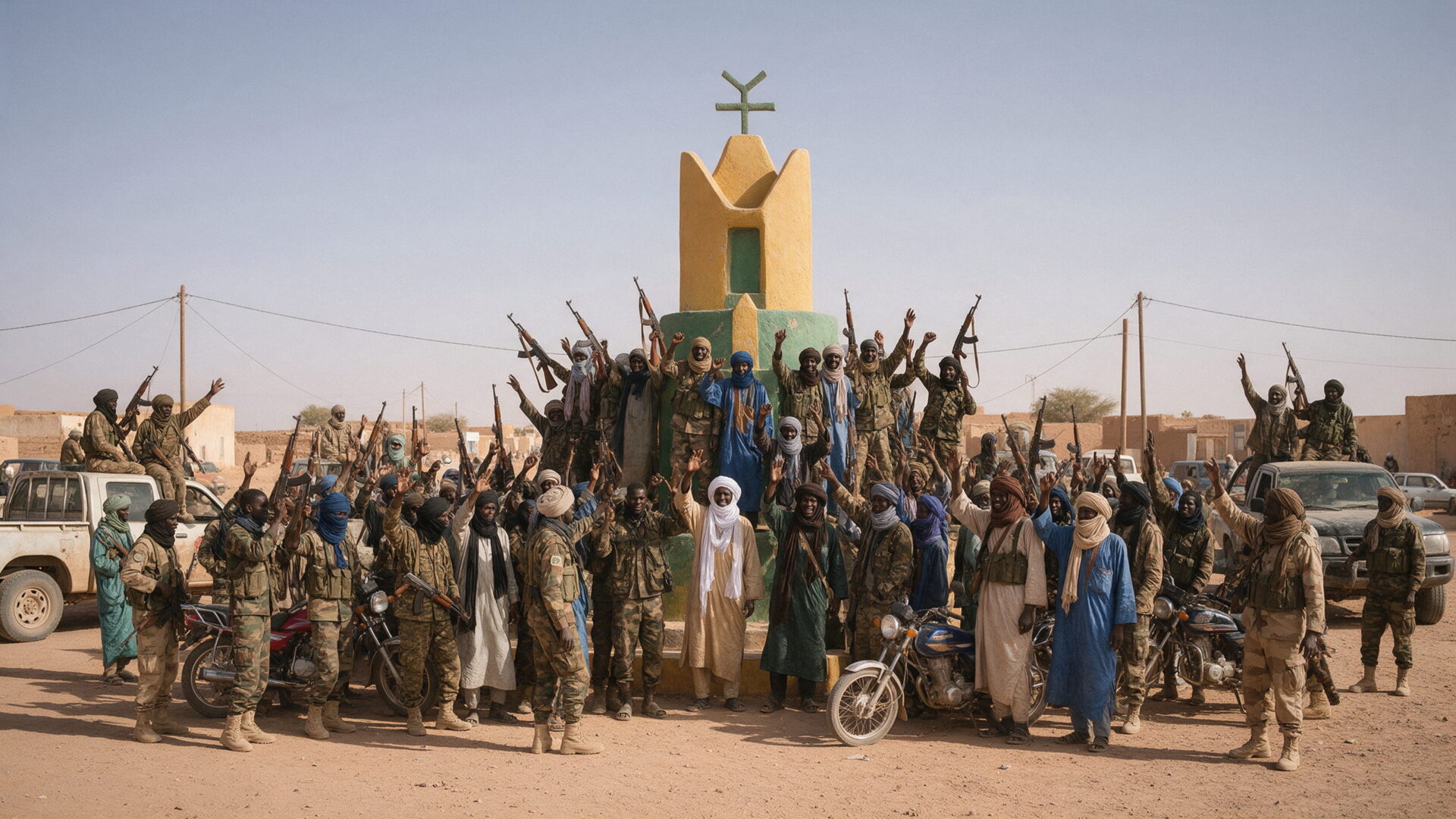
In 2026, Mali became what the Timbuktu Institute calls an ‘open-air laboratory’ for artificial intelligence (AI) in warfare. On 25 April 2026, coordinated attacks by the al-Qaeda-linked Jama’at Nusrat al-Islam wal-Muslimin (JNIM) and the Tuareg-led Azawad Liberation Front (FLA) killed Mali’s defence minister, Sadio Camara, and forced Malian forces and their Russian Africa Corps partners to withdraw from Kidal. A parallel contest unfolded online. On 9 September 2026, the Dakar-based Timbuktu Institute published Algorithms at War, which examines how generative AI is used by JNIM, the FLA, Mali’s transitional authorities and Africa Corps.
This paper asks: how does generative AI amplify the hybrid-threat mix of propaganda, drones, blockade and political manipulation in Mali, and what does this imply for the struggle for legitimacy between state, non-state and foreign actors? The case matters beyond Mali, because, as one analyst argues, the insurgent model of cheap drones, blockades and media-savvy operations could be portable across the Sahel and into coastal West Africa.
Hybrid threats are understood here as the coordinated use of military and non-military instruments (information operations, irregular forces, economic pressure) to undermine an adversary’s cohesion while avoiding triggering a clear response. Within this framework, AI is treated as a multiplier, not a cause. The Timbuktu Institute’s director makes the same point: AI does not create new divisions in Mali but amplifies existing ones. Three mechanisms are examined:
- Scale: A shift from ‘cottage industry to industrial production’ of propaganda, in the director’s words.
- Personalisation: Automatic translation and voice dubbing could allow recruitment messages to be disseminated in around fifteen Sahelian languages, reaching people who cannot read.
- Deniability: Synthetic personas and AI-generated comments obscure who is behind content.
An asymmetric information war
Adoption is uneven. Africa Corps and the transitional authorities demonstrate a ‘state-level, professionalised and systematic’ use of generative AI, including fake videos, anti-Western deepfakes and AI-generated comments. Researchers have identified nineteen Russian disinformation campaigns across Mali, Burkina Faso and Niger since 2018, and some content has attracted nearly five million views. The FLA’s online supporters use synthetic characters, such as the AI-generated ‘Azzghim’, a supposed Tuareg fighter critical of Africa Corps. JNIM remains at the rudimentary end: its media arm released AI-generated posters in June 2026.
Researchers have identified nineteen Russian disinformation campaigns across Mali, Burkina Faso and Niger since 2018, and some content has attracted nearly five million views
Tweet
Table 1. AI use by actor type in Mali’s conflict (2026)
| Actor | Observed AI use | Maturity | Evidence |
|---|---|---|---|
| Africa Corps and transitional authorities | Fake videos, anti-Western deepfakes, generated comments; narratives blaming France and Ukraine | Professionalised, systematic | Documented in the Timbuktu Institute study |
| FLA networks | Synthetic personas on social media (e.g. ‘Azzghim’); AI-character TikTok accounts | Creative, decentralised | Documented |
| JNIM | AI-generated posters; multilingual recruitment is a projected risk | Rudimentary, experimental | Documented (posters); prospective (recruitment) |
The drone dimension
The kinetic dimension is equally transformed. JNIM’s armed drone strikes reportedly rose from fewer than ten in 2024 to around eighty in 2025. Africa Corps announced in early June 2026 that it was deploying first-person view (FPV) kamikaze drones, a move that one outlet interpreted as catching up with insurgents who ‘got there first’. The same source reports the FLA’s use of fibre-optic drones, which are resistant to jamming, and notes that footage of drone strikes is posted online, turning each strike into an information operation. Researchers warn that AI could move beyond information warfare into military operations such as drone strikes, but such applications remains largely prospective.
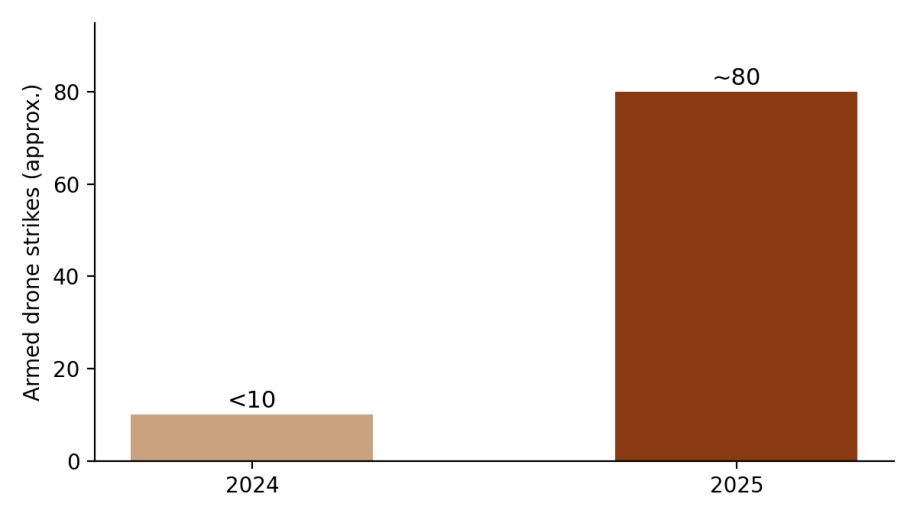
Tweet: JNIM’s armed drone strikes reportedly rose from fewer than ten in 2024 to around eighty in 2025. Africa Corps announced in early June 2026 that it was deploying first-person view (FPV) kamikaze drones, a move that one outlet interpreted as catching up with insurgents who ‘got there first’.
Tweet
The info-kinetic loop
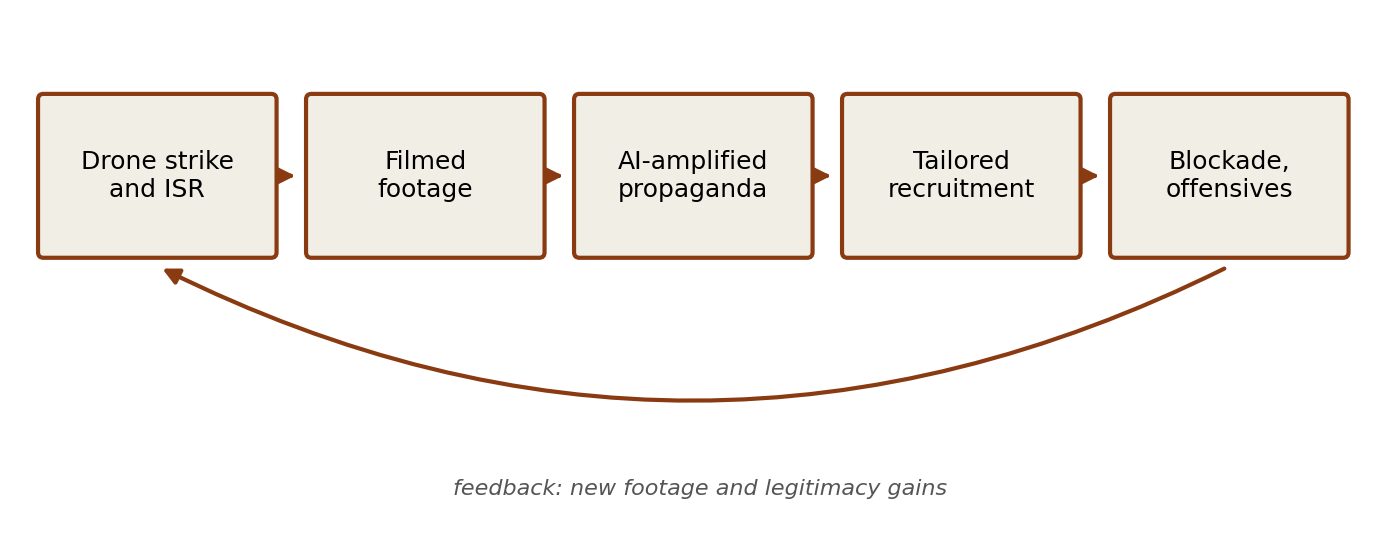
The analytical core is the fusion of the two domains. Ashour describes a chain in which drone footage becomes propaganda, propaganda becomes recruitment and recruitment sustains blockade warfare. Generative AI can accelerate each link: producing, translating and tailoring content, and masking its origin.
Analysis
Table 2. Hybrid-threat domains and the role of AI
| Domain | Observed in 2026 | AI multiplier effect | Strength of evidence |
|---|---|---|---|
| Information | Deepfakes, synthetic personas, generated comments | Scale, deniability, personalisation | Documented |
| Drones and ISR | JNIM, FLA and Africa Corps drone use; fibre-optic drones | Possible targeting support | Reported; AI role prospective |
| Blockade and politics | JNIM blockade logic around Bamako; contest for legitimacy | Narrative amplification | Reported; no direct AI evidence |
| Media environment | Tight state control of media and exclusion of international outlets | Raises impact of state AI content | Documented |
Three findings emerge. First, the asymmetry lies in resources, not intent. States and their partners can establish an industrial pipeline; insurgents improvise. Second, AI’s impact is shaped by the information environment. The Timbuktu Institute notes that the Alliance of Sahel States governments have tightened their control over domestic media and cut off access to international outlets, potentially making state-aligned synthetic content more effective. Third, the most serious potential risk is individualised recruitment: the study’s director warns that jihadist groups may increasingly recruit individuals ‘person by person’ rather than en masse.
However, this evidence relies on one think-tank study relayed by media, specialist defence outlets and belligerents’ own claims, several of which are difficult to verify independently. Advanced military uses of AI are described as largely prospective. Findings should therefore be treated as hypotheses to be tested through fieldwork and platform-level data analysis.
Implications and research agenda
- Verification capacity: Regional bodies such as the African Union (AU) could support independent verification and attribution of synthetic content in conflict settings.
- Language access: Counter-messaging and detection tools need to provide coverage for Fulani, Bambara, Tamasheq and other Sahel languages.
- Calibrated regulation: Responses should avoid enabling censorship under the guise of countering AI disinformation.
- Research: Comparative research on Burkina Faso and Niger; platform-level analysis of synthetic accounts; and tracking the shift from propaganda to AI-assisted targeting support should be undertaken.
Conclusion
Mali in 2026 demonstrates that AI’s contribution to hybrid threats is cumulative and conditional: it amplifies existing practices, depending on their capacity and the openness of the information environment. The priority for scholars and policymakers is to conduct evidence-based monitoring of the information-kinetic loop before AI-assisted targeting and personalised recruitment move from warning to reality.
Abraham Ename Minko, Ph.D is a Professor of Political Science and International Relations at Pan African University. Tekang P. Kwachuh, Ph.D is a Senior Research Fellow at Anadolu University, Türkiye.

