
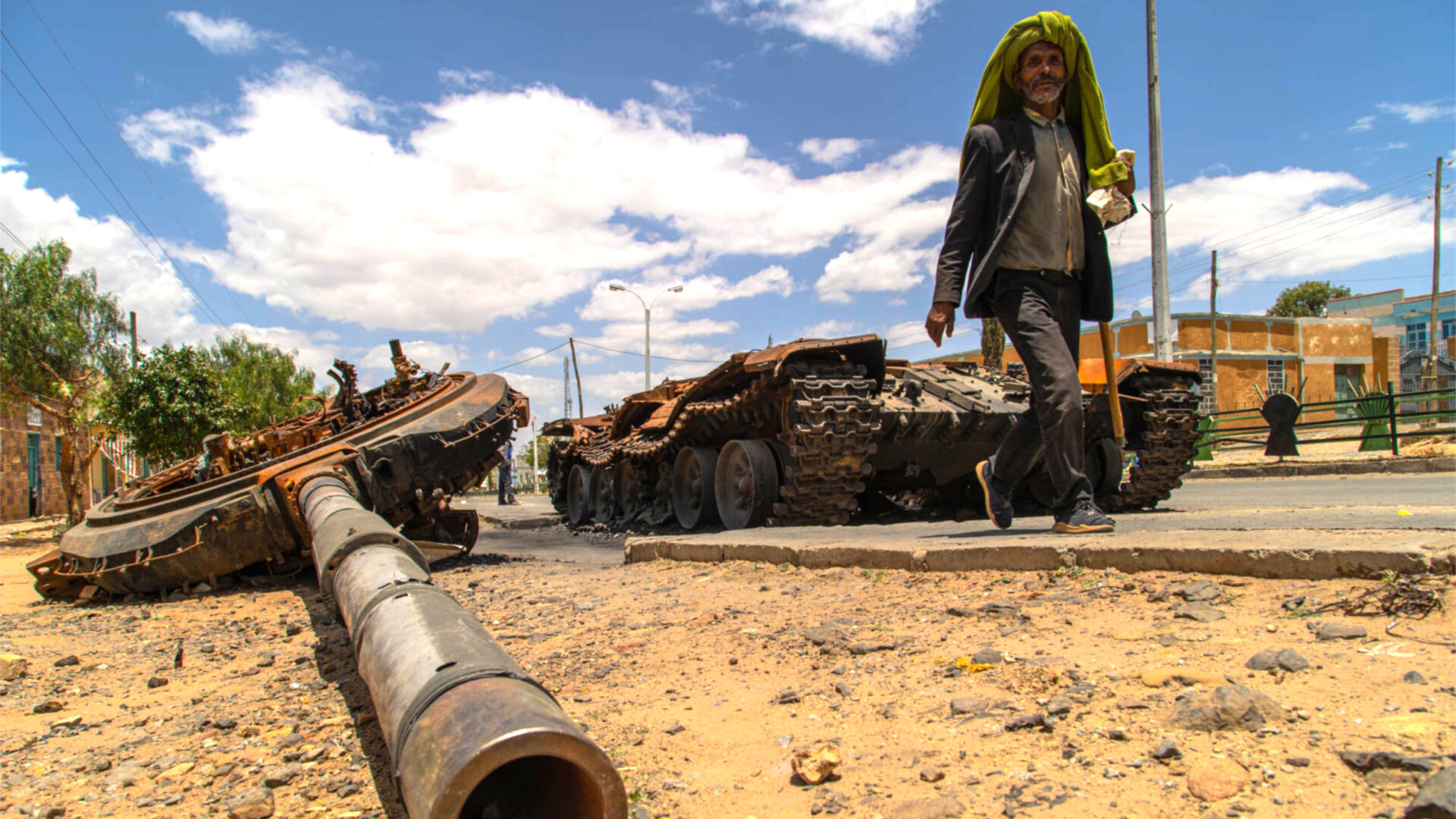
The Pretoria Peace Agreement of November 2022 aimed to end the cycle of violence in Ethiopia. After a nearly two-year conflict, and an estimated 600 000 deaths, the officially titled Agreement for Lasting Peace through a Permanent Cessation of Hostilities (CoHA) appeared to have silenced the guns in Tigray and other parts of Ethiopia. However, the journey towards lasting peace is crumbling, and the current sounds and images from Ethiopia are all too painfully familiar.
In his September 2026 article, Ismail Abuka notes that the peace architecture signed four years ago did little to engage with the interplay of the ‘core systemic collapse’. The peace agreement, like many across Africa and the world, only functioned to delay and localise long-standing systemic drivers of conflict that have both regional and global implications.
In the last week of September 2026, reports indicated that the Tigrayan People’s Liberation Front (TPLF) had seized airports in Tigray, launched attacks in the Amhara and Afar regions, and carried out heavy attacks along multiple fronts in the northern territories of Ethiopia. The renewed fighting appears to feature old and new alliances, players and patterns, yet the underlying drivers remain stubbornly the same. The stated objective of the newly formed alliance, the Ethiopian Peoples’ Forces Alliance for Survival, made up of seven groups including the TPLF, Fano and the Oromo Liberation Army (OLA), is to dislodge the current government and establish an inclusive transitional governance structure.
Some of the most troubling questions in the current cycle of violence include; does this renewed cycle of violence pose an existential threat to the region and the continent? Is this cycle of violence symptomatic of structural disintegration in Ethiopia and the east and Horn of Africa regions? And, do opportunities exist to learn and strengthen peacebuilding efforts in Ethiopia?
Ethiopia and its symbolism
During crises such as this, Ethiopia’s unique and profound symbolic weight for Africa and the world is often overlooked. This symbolism is rooted in its historical resistance against colonialism, most significantly in the Battle of Adwa 130 years ago. Ethiopia is a compelling emblem of African dignity, unity, and, above all, sovereignty. African solidarity is physically and symbolically domiciled in Addis Ababa, the capital, which is also the headquarters of the African Union (AU). It bears repeating that conflict and instability in Ethiopia is directly felt by the people of Africa.
Is this cycle of violence symptomatic of structural disintegration in Ethiopia and the east and Horn of Africa regions
Tweet
The question of the unconditional right to self-determination
The 1995 Constitution of Ethiopia upholds the right to self-determination. Article 39 of the Constitution grants ‘nations, nationalities, and peoples’ in Ethiopia the unconditional right to self-determination, including the right to secession. On paper, this should serve as a blueprint for peace, coexistence, governance and collective agency to break cycles of violence not only in Ethiopia, but also in other parts of the world.
Yet, the application of this framework that provides for ethnic-based federalism seems to function as a fault line for tensions and conflict, rather than a resource for peace. Ethnic-based divisions are routinely contested, particularly in the context of internal autonomy, regional borders and central authority, often stoked by manipulation by the political class.
The Pretoria Peace Accord of 2022 does not explicitly mention the term self-determination; instead, it reaffirms Ethiopia’s sovereignty and territorial integrity. Scholars and practitioners of peacebuilding have noted that upholding self-determination can serve as a resource for peace. In Self-Determination: A Resource of JustPeace, Aküm Longchari calls for the re-imagining of self-determination, not as a cause of conflict or a synonym for secession, but as a resource for building ‘JustPeace’, that is, a peace grounded in justice, dignity and political participation. Longchari nullifies dominant Westphalian narratives that treat self-determination as inherently violent, separatist or destabilising.
The existential threat of the Ethiopian conflict
The current conflict in Ethiopia is considered an existential threat as it represents the convergence of multiple, previously distinct wars into a single crisis that directly challenges the survival of the Ethiopian state. The impending transformation of various armed formations into a nationwide coalition, under the umbrella of the Ethiopian Peoples’ Forces Alliance for Survival, threatens the survival of the current federal state and government, with implications for the Horn and East African regions. If the alliance simultaneously opens battlefronts in Tigray, Amhara, Oromia, Afar, Somali and Benishangul-Gumuz, it would be difficult for the Addis Ababa government to contain, let alone pacify.
It is also reported that external actors stand ready to benefit from the escalation. It is possible that, for instance, the United Arab Emirates, Eritrea, Sudan, Egypt, the United States and Israel will seek to advance proxy wars, due to historical factors, or simply to advance their political economy interests. Should this renewed cycle of violence metastasise, it could then have an impact on Ethiopia’s neighbours and beyond. Therefore, the current conflict is a convergence of an alliance of seven armed groups, the collapse of the Pretoria Peace Accord, the structural logic of ethnic federalism and power politics, and regional and international proxy dynamics.
But, Ethiopia can and will survive. Against this background, what are the opportunities for peace at a time when the world is witnessing unprecedented levels of violence in other parts of the world?
Second, is the need to revisit the Pretoria Peace Accord in light of the current dynamics and recognise that ‘pacification’ will only work in the short term
Tweet
Opportunities for peace
Three proposals from a people-centred lens of the unconditional right to self-determination are proposed:
First, there is the need to revisit self-determination as a resource for peace and justice. As Aküm Longchari argues, self-determination (as enshrined in the 1995 Constitution of Ethiopia) calls on us to reimagine self-determination not as a cause of conflict or a synonym for secession (as currently interpreted by the political class), but as a resource for building peace, grounded in justice, dignity and political participation. Offering his experience in Nagaland, Longchari proposes a decolonial reimagining of self-determination that is not determined by the state but by peoples’ determination, which centres the voices of the marginalised and promotes constructive resolution of disputes through organic indigenous mechanisms of political dialogue and transformation.
Second, is the need to revisit the Pretoria Peace Accord in light of the current dynamics and recognise that ‘pacification’ will only work in the short term. The AU, in concert with organisations in Ethiopia, could lead a political process that expands and deepens the definitions of self-determination and political frameworks of inclusivity, creative and transitional justice and collective healing. This should include taking a bold political stance with regard to external actors.
Third, civil society and peoples’ organisations should seize the initiative and advance a truly decolonial people-driven approach, devoid of power politics. Ethiopian citizens, at home and abroad, being the ultimate custodians of cultural and grassroots resources, should engage in a people-driven process that reimagines self-determination and structural innovation in the quest for a peaceful and just Ethiopia that retains the leadership and symbolism of the nation.
Babu Ayindo, is a storyteller, researcher, and practitioner in arts and decolonial peacebuilding.
